
Parent Confidential I: College is Their Job

Orientation #2 begins this week and I am excited for the upcoming “Meet the Parents” session.
In my day job I am Dean of the College of Education, Health and Human Development at Montana State University and I have the great pleasure of connecting with “nervcited” parents at four orientation sessions over the summer.
I say “nervcited” because it is the perfect blend of “nervous” and “excited”, which is precisely how most parents feel when they are taking their first kid to college.
They are simultaneously nervous. Will my kid make friends? Will they know how to use the washing machine?
AND
They are excited. This college has the coolest dining hall; I want to eat there. My kid can finally explore their interest in wild clay with a world-renowned ceramicist!!
This nervcitedness comes out during the “Meet the Parents” question and answer session. In this three-part blog series, I will share my responses to the most common questions I field from parents.
Parents are uncertain how much their student should study
Small aside: As a university professor and academic leader, I always speak to parents about their student. While it is completely appropriate for Riley's parents to refer to her as their "kid," I never talk to them about their kid. To university professors and staff, Riley is an adult who is a student.
Okay, back to what I was saying about studying.
Parents ask at every orientation session just how much time their student should spend studying. My answer almost always takes them aback.
I invite them to encourage their student to consider studying/preparing for and going to class like it is their job. Because it is.
And frankly, it’s an odd job given that it is a job one pays to go to (or not go to as is too often the case).
So here’s the thing, if a student registers for four or five in-person classes, that is a little less than 12 to 15 hours in a college classroom, respectively. Showing up for the class, while critically important, is rarely sufficient for doing well in the course and mastering its content.
Crushing college takes time. Time spent:
Reading the assigned texts and articles.
Drafting, revising (yes, rarely is the first take the best take), and finalizing an assignment before submission.
Conducting a laboratory experiment and writing up the results
Engaging in and reflecting on a field-based experience.
Planning the week
I invite parents to sit with their student and plan out their class and study schedule for a 40-hour work week, which includes flex time.
Below is Riley’s draft schedule. She is taking five, 3-credit hour courses in a range of subjects that address many universities’ core requirements.
At many universities Monday, Wednesday and Friday courses are 50 minutes in duration; the other 10 minutes of the hour is “passing period” and allows students to get to their next class on time. Tuesday, Thursday courses are 75 minutes with the 10 minute passing period.
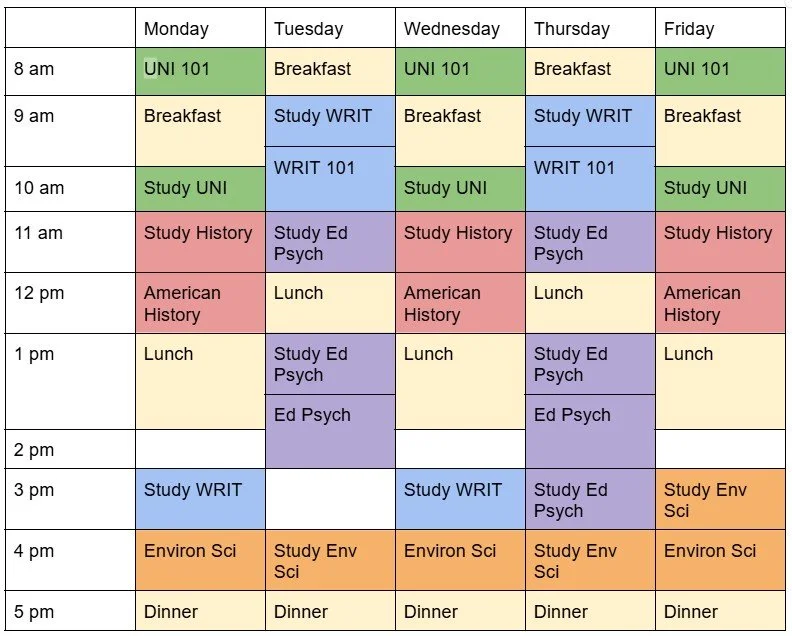
Notice that each of Riley’s classes meets for 2.5 total hours each week (50 minutes 3 or 75 minutes 2 = 150 minutes) and she will study an additional 3 hours, minimally, each week for each class. “Studying” may include: reading course material, working on assignments, completing labs, etc.
If Riley follows this schedule, she will attend class for 12.5 hours per week and study 15 hours per week. Taken together, this is less than a full-time job and yet, it is more than the 14.3 hours the average U.S. college student spends studying (Check out this interesting brief on how college students spend their time.)
When students start college seeing that attending and studying for class is their job, they develop important time management habits which are key skills that employers expect in new hires. By sitting down with your student and scheduling out the work of going to college, you are helping them develop an essential workplace competency.
Students Drive
People often talk about student success as if it is a destination rather than what it is, a journey. I often tell parents that their student is the driver on the college journey. Parents, professors, and advisors are important passengers. Together, we aim to be good company on the student’s journey. We may make suggestions about the route to take (I think of the schedule as a perfect example of route finding), when it may be a good time to pull off and get gas, or recommend a new playlist. Yet, at the end of the day, the students are at the wheel.
Here’s to a great road trip!
I welcome hearing from you. If you are a parent/guardian/family member of a first-year college students, what questions do you have?
If you are a parent of a student who has completed their first college year, what worked with your college-bound student? How have you been good company on their journey? I invite you to leave a question or comment and contribute to our community.